

TL;DR:
- A segregated account legally separates client funds from a firm’s assets and protects those funds from creditors. Maintaining strict, real-time record-keeping and reconciliation is essential for operational integrity and regulatory compliance. Proper segregation enhances client trust, reduces insolvency risk, and demonstrates operational discipline.
A segregated account is a distinct financial account that keeps client funds legally separate from a firm’s own operating capital, protecting those assets from the firm’s creditors. This separation is not optional for most regulated firms. Regulatory frameworks including Securities Exchange Act Rule 15c3-3 in the U.S. and MiFID II in the EU require firms to maintain this separation under strict custodial standards. Non-compliance carries real consequences: heavy financial fines, suspension of operating licenses, and lasting reputational damage. For business owners and financial professionals, understanding what is a segregated account is the first step toward building a compliant, trustworthy operation.
What is a segregated account and how does it work?

A segregated account operates on one foundational legal principle: client funds held in the account never belong to the firm. The firm manages those funds, but ownership stays with the client at all times. This distinction matters most when a firm faces insolvency. Client funds are legally exempt from the firm’s creditors in bankruptcy, meaning they cannot be seized to satisfy the firm’s debts.
Operationally, maintaining this separation requires more than opening a separate bank account. Firms must keep precise, real-time bookkeeping that tracks every client holding independently. Reconciliation must happen continuously, not just at month-end. Auditors verify both segregation and the integrity of internal controls that prevent unauthorized transfers between client and corporate funds.
The accounting treatment reinforces this separation. Under Generally Accepted Accounting Principles, firms record segregated accounts as liabilities on their balance sheets, not as assets. That treatment signals clearly that the firm holds these funds in trust, not as its own property.
Segregated accounts appear across multiple industries where this separation is legally required:
- Broker-dealers under SEC Rule 15c3-3 must hold client securities and cash in accounts separate from the firm’s proprietary assets.
- Escrow agents hold funds on behalf of transacting parties until contractual conditions are met, with no right to use those funds for operating expenses.
- Insurance companies maintain segregated pools for policyholder reserves, governed by state insurance regulators.
- Futures commission merchants operate under CFTC rules requiring strict separation of customer margin funds.
- Attorneys maintain client trust accounts under bar association rules, with violations resulting in disbarment.
Pro Tip: If your firm operates across EU jurisdictions, review your MiFID II obligations with a compliance officer before setting up account structures. The rules on eligible custodians and reconciliation frequency are more specific than most firms expect.
Why use segregated accounts: benefits beyond compliance
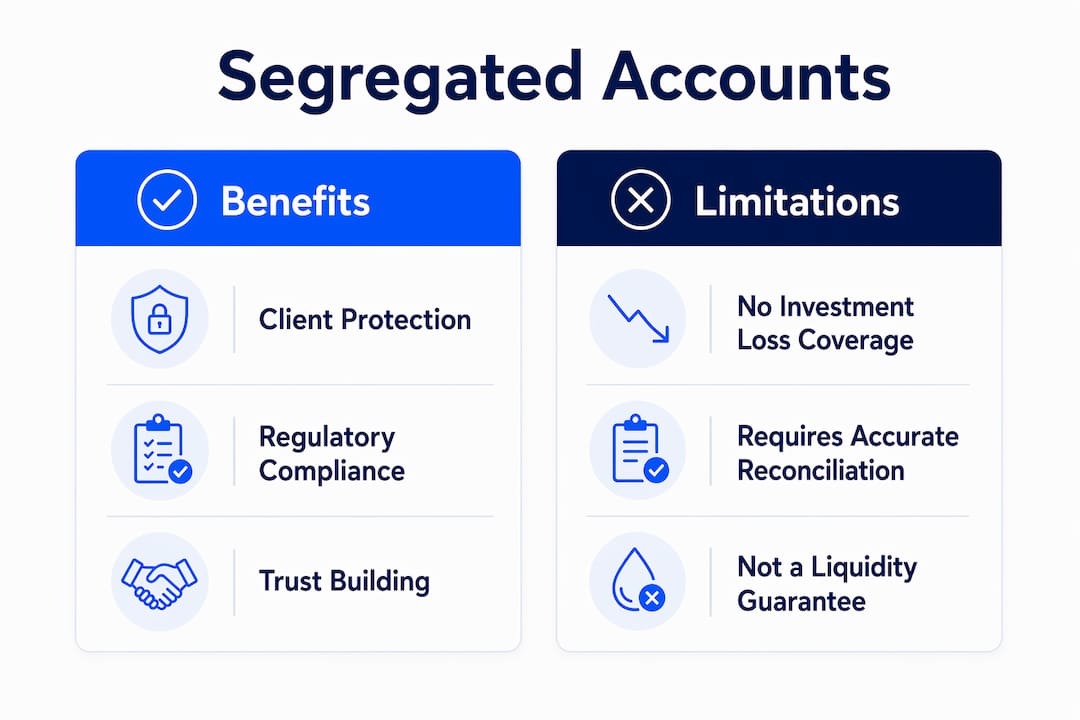
The most direct benefit of a segregated account is protection from firm insolvency. If a firm collapses, client assets held in a properly maintained segregated account are not part of the bankruptcy estate. Creditors cannot reach them. This protection is the reason regulators mandate segregation in the first place.
The benefits extend well beyond legal protection, though. Firms with strong segregation practices are better positioned to reassure clients during market volatility and regulatory scrutiny. A client who knows their funds are legally ring-fenced is far less likely to withdraw assets during a market downturn or a news cycle about industry instability.
Segregated accounts also support personalized investment management. Broker-dealer segregation aligns investment decisions with each client’s specific risk tolerance and goals, unlike pooled structures where decisions are centralized across all investors. This alignment directly supports Know Your Client regulatory obligations.
Here are the core advantages financial professionals should communicate to clients:
- Insolvency protection. Client assets cannot be seized by the firm’s creditors, regardless of the firm’s financial condition.
- Return clarity. Interest, dividends, and capital gains generated within the account belong to the client and are reported for tax purposes accordingly.
- Goal alignment. Each account reflects the individual client’s investment mandate, not a blended strategy.
- Regulatory confidence. Proper segregation demonstrates compliance to regulators, reducing the risk of enforcement actions.
- Reputational capital. Clients, auditors, and counterparties view segregation as a mark of operational discipline.
Pro Tip: When onboarding new clients, explain segregation in plain terms: their money sits in a separate account with their name on it legally, and the firm cannot touch it for its own purposes. That single explanation builds more trust than any marketing material.
Common types of segregated accounts and industry examples
Segregated accounts take different forms depending on the industry and regulatory context. The structure is consistent across all of them: client funds stay separate, and the firm acts as custodian rather than owner. Attorney trust accounts, escrow accounts, brokerage client accounts, and futures commission merchant accounts each serve this purpose for distinct operational and regulatory reasons.
One important distinction exists between segregated accounts and omnibus or pooled accounts. The table below compares the two structures across key criteria.
| Feature | Segregated accounts | Pooled or omnibus accounts |
|---|---|---|
| Ownership tracking | Per-client, individually identified | Aggregated across all clients |
| Insolvency protection | Full, per client | Partial, depends on structure |
| Regulatory complexity | Higher, more documentation required | Lower, simpler administration |
| Customization | Tailored to individual mandates | Standardized across the pool |
| FDIC pass-through insurance | Applies per underlying owner | May apply, but harder to document |
FDIC pass-through insurance is a specific advantage of properly structured segregated bank accounts. Coverage extends to each underlying owner up to $250,000, rather than treating the entire account as a single depositor. This matters for law firms, escrow agents, and fintech platforms holding client funds in bank accounts. The firm must maintain records that identify each client’s share clearly enough for the FDIC to apply the pass-through treatment.
Regulatory oversight varies by industry. The SEC and FINRA govern broker-dealer segregation in the U.S. The CFTC governs futures commission merchants. State bar associations govern attorney trust accounts. In Europe, MiFID II sets the standard for investment firms, with national competent authorities enforcing it at the country level.
What risks do segregated accounts not cover?
Segregation protects against firm insolvency. It does not protect against every financial risk a client faces. Segregated accounts do not guarantee protection from investment losses or bank failures beyond insured limits. Clients need to understand this distinction clearly before assuming their assets are fully insulated from all risk.
The specific risks that segregation does not address include:
- Investment performance risk. If the assets held in the account lose value due to market movements, the client bears that loss. Segregation is about ownership protection, not investment insurance.
- Bank failure beyond FDIC limits. If the custodian bank fails and balances exceed FDIC pass-through coverage, clients may face losses on the excess.
- Custodian misconduct. A disreputable custodian can misuse or misreport client assets even within a nominally segregated structure. Choosing a regulated, audited custodian is not optional.
- Record-keeping failures. Inadequate documentation can destroy the legal protection segregation provides. If a firm cannot prove which assets belong to which client, courts may treat the funds as commingled.
- Unauthorized internal transfers. Without strong internal controls, employees can move funds between client and corporate accounts. This is both a regulatory violation and a criminal risk.
The practical takeaway is that segregation is a legal structure, not a guarantee. Firms that treat it as a checkbox rather than an operational discipline expose both themselves and their clients to serious risk. For financial professionals managing compliance, the internal controls around segregation matter as much as the account structure itself.
Best practices for managing segregated accounts effectively
Effective management of segregated accounts requires consistent operational discipline, not just the right account structure. The legal protection segregation provides only holds if the firm can demonstrate, at any moment, that client and corporate funds have never mixed.
The following practices define a well-run segregation program:
- Real-time reconciliation. Match client holdings to account records daily, not monthly. Errors compound quickly and become harder to unwind the longer they go undetected.
- Clear record separation. Maintain distinct ledgers for client assets and corporate assets. Every transaction touching a segregated account must be labeled, dated, and traceable.
- Regular audits. Internal audits should verify segregation integrity quarterly. External audits provide independent confirmation and satisfy most regulatory requirements.
- Staff training. Every employee who touches client accounts must understand what segregation means legally and what actions constitute a violation. Ignorance is not a defense with regulators.
- Technology controls. Compliance software that flags unauthorized transfers, generates reconciliation reports, and maintains audit trails reduces human error significantly. For firms managing multiple client accounts, manual processes are a liability.
Pro Tip: Set up automated alerts for any transaction that moves funds between a client account and a corporate account. Even legitimate transfers should trigger a review. The audit trail this creates is your best defense in a regulatory examination.
Firms operating under EU banking regulations face additional documentation requirements under MiFID II, including client asset reports and reconciliation records that must be available to regulators on request. Building these processes into daily operations from the start is far less costly than retrofitting them after a compliance finding.
Key Takeaways
Segregated accounts protect client assets by legally separating them from firm funds, and that protection only holds when firms maintain rigorous real-time records, choose reputable custodians, and treat segregation as an operational standard rather than a one-time setup.
| Point | Details |
|---|---|
| Legal ownership stays with the client | Client funds in segregated accounts are exempt from the firm’s creditors in bankruptcy. |
| GAAP requires liability treatment | Firms must record segregated accounts as liabilities, not assets, on their balance sheets. |
| Segregation does not cover investment losses | Clients bear market risk; segregation protects ownership, not performance. |
| Real-time reconciliation is non-negotiable | Daily reconciliation and audit trails are the operational foundation of valid segregation. |
| FDIC pass-through applies per client | Each underlying owner receives up to $250,000 in deposit insurance when records are properly maintained. |
Why segregated accounts are more than a compliance checkbox
The firms I see struggle most with segregated accounts are not the ones that ignore the rules. They are the ones that set up the structure correctly and then let the operational discipline slip. They open the right accounts, label them properly, and then skip reconciliation for two weeks because the team is busy. That is where the legal protection actually breaks down.
Regulatory scrutiny has intensified since the financial disruptions of the early 2020s. Regulators are not just checking whether a segregated account exists. They are reviewing reconciliation frequency, audit trails, and whether staff can explain the firm’s segregation policy without reading from a manual. The bar is higher than it was five years ago.
The most common misunderstanding I encounter is that clients believe segregation means their money is safe from all risk. It means their money is safe from the firm’s risk. That is a meaningful but specific protection. Firms that communicate this distinction clearly build more durable client relationships than those who let clients assume broader coverage.
A culture of compliance around segregated accounts starts with leadership treating it as a core operational standard, not a legal formality. When the people running the firm take it seriously, the rest of the organization follows. When they treat it as paperwork, violations become inevitable.
— dd
Demivolt’s tools for financial compliance and account management
Financial professionals who manage client funds across borders face a specific challenge: verifying that account details are accurate before any transaction clears. One error in an IBAN can delay payments, trigger compliance flags, or send funds to the wrong account entirely.
Demivolt offers a free IBAN validation tool built on the ISO 13616 standard, letting you verify international bank account numbers instantly before processing payments. For firms managing segregated accounts across multiple jurisdictions, that verification step reduces errors and supports the audit trail regulators expect. Demivolt’s broader suite of free SEPA tools covers additional payment compliance needs for SMEs and financial professionals operating within the EU payment infrastructure. For firms looking at compliant business banking built around dedicated IBAN accounts and clear account structures, Demivolt’s platform is designed with those operational requirements in mind.
FAQ
What is a segregated account in simple terms?
A segregated account is a bank or investment account that holds client funds separately from a firm’s own money. The client retains legal ownership, and the firm cannot use those funds for its own operations or debts.
Are segregated accounts required by law?
Regulations including SEC Rule 15c3-3 in the U.S. and MiFID II in the EU legally require many firms to maintain segregated accounts. Non-compliance can result in fines, license suspension, and reputational damage.
Does a segregated account protect against investment losses?
No. Segregation protects client assets from the firm’s insolvency and creditors, but it does not protect against losses caused by market movements or poor investment performance.
What is the FDIC pass-through rule for segregated accounts?
FDIC pass-through insurance extends deposit coverage to each underlying client owner up to $250,000, provided the firm maintains records that clearly identify each client’s share of the account.
How often should firms reconcile segregated accounts?
Firms should reconcile segregated accounts daily. Real-time reconciliation prevents errors from compounding and provides the audit trail regulators require during examinations.
Recommended
- Demivolt | Blog – Why Dedicated Business Accounts Matter for European SMEs
- Demivolt | Blog – Business Financial Control Explained for SME Owners
- Demivolt | Blog – Types of Business Bank Accounts: Find the Right Fit for Your SME
- Demivolt | Blog – How to manage multiple accounts: A step-by-step guide for SMEs