

TL;DR:
- Effective client onboarding streamlines the transition from agreement to engagement, reducing early churn. Using automation tools, structured steps, and clear communication ensures faster, more consistent onboarding that builds long-term relationships. SMEs should prioritize building a repeatable process, leveraging technology, and monitoring key metrics to improve client retention.
Client onboarding is the structured process of transitioning a new client from signed agreement to active, productive engagement. Done well, it reduces early churn, accelerates time to first deliverable, and builds the kind of trust that turns one-time buyers into long-term partners. For SMEs, where every client relationship carries real weight, knowing how to onboard new clients with speed and consistency is one of the highest-leverage operational decisions you can make. Tools like Calendly, onboarding portals, and workflow automation platforms have made this process faster and more repeatable than ever.
What are the essential steps to onboard new clients effectively?
A complete client onboarding process covers 12 structured steps, from contract signing to first deliverable, ideally completed within 7–14 days. That window matters. The top 20% of service businesses complete onboarding in five days or fewer, while businesses relying on scattered email threads risk losing 25–35% of new clients within 90 days. Speed and structure are not separate goals. They are the same goal.
Here are the core steps for integrating new clients from day one:
- Send a welcome email within one hour of contract signing. Include a direct calendar booking link via Calendly or Cal.com. This collapses scheduling friction from multiple back-and-forth emails to a single click.
- Share a discovery questionnaire. Keep it to 10–15 fields. A well-designed intake form takes 10–15 minutes to complete and surfaces 80% of alignment risks before the kickoff call.
- Set a document submission deadline. Name every required file clearly and give a specific due date. Vague requests produce delayed or incomplete submissions.
- Collect credentials and access securely. Use a password manager or secure portal. Never request sensitive data over plain email.
- Conduct an internal handoff. Brief the delivery team before the kickoff call. Clients should never have to repeat themselves to multiple people.
- Run the kickoff call. Confirm goals, timelines, and communication channels. Document everything discussed in writing immediately after.
- Send a kickoff summary email. This written record prevents misremembrance and sets the professional tone for the entire engagement.
- Assign a dedicated point of contact. Clients need one person to call. Ambiguity here creates friction and erodes confidence fast.
- Deliver the first milestone within the agreed window. Early delivery signals competence and builds momentum.
- Schedule a first-week check-in. Ask three direct questions: Is everything clear? Is anything missing? Is the pace right?
- Map out a 30-day milestone plan. Clients who see a clear roadmap stay engaged longer.
- Log all onboarding activity in your CRM or project management tool. This creates an auditable record and supports future process improvements.
Pro Tip: Send the welcome email and calendar link before you close your laptop on the day the contract is signed. Clients who wait more than 24 hours for first contact often interpret silence as disorganization.
Which tools support effective client onboarding workflows for SMEs?

The right tools remove the manual work that slows onboarding down. Enforced workflow automation is the single biggest lever SMEs can pull. Without gated tasks, onboarding becomes a high-friction checklist that requires constant manual follow-up. With them, the system chases the client so you do not have to.
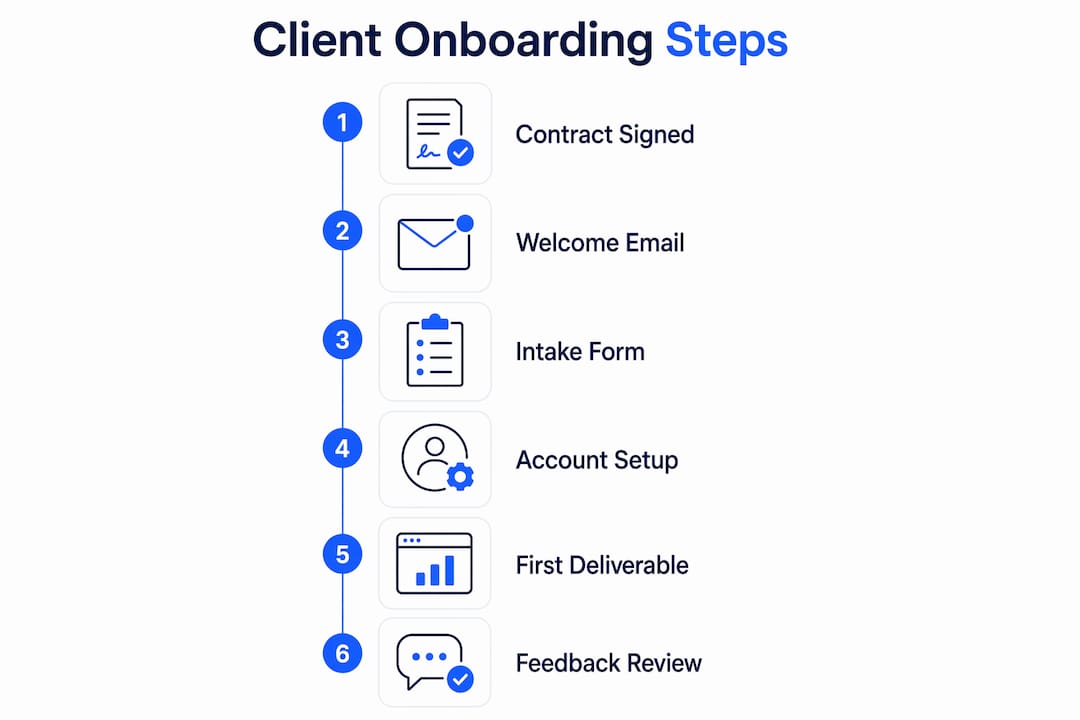
The table below covers the main tool categories and what each one does in practice.
| Tool category | Example tools | Primary function |
|---|---|---|
| Scheduling | Calendly, Cal.com | Eliminate back-and-forth by letting clients book directly |
| Client portals | HoneyBook, Dubsado | Centralize documents, forms, and communication in one place |
| Document management | PandaDoc, DocuSign | Named file requests with deadlines and automatic reminders |
| Project management | Asana, Monday.com | Track onboarding task status and milestone completion |
| CRM | HubSpot, Zoho CRM | Log client history, automate follow-ups, and flag stalled onboarding |
Each category solves a specific failure point. Scheduling tools eliminate the three-to-five email exchanges that typically precede a kickoff call. Document tools send automatic reminders when a client has not submitted required files, removing the need for manual chasing. Project management tools give your team a shared view of where each client sits in the process.
Pro Tip: Use a client portal that enforces gated steps. If a client cannot proceed to step three without completing step two, you prevent the most common onboarding failure: tasks completed out of order or skipped entirely.
Financial onboarding best practices for SMEs add another layer of complexity, particularly when payment setup and compliance verification are part of the process. In those cases, dedicated fintech tools that handle IBAN validation and SEPA payments reduce friction at the financial setup stage.
What common mistakes should SMEs avoid during client onboarding?
Most onboarding failures are predictable. They follow the same patterns across industries, and all of them are preventable with the right structure in place.
The most damaging mistakes include:
- Relying on unstructured email threads. Email is not an onboarding system. Threads get buried, tasks get missed, and clients interpret slow responses as poor service. Businesses that depend on email alone risk losing a significant share of new clients within the first 90 days.
- Building intake forms that are too long. Forms with more than 15 fields cause abandonment and stall momentum before the relationship has started. Ask only what you need to begin work.
- Skipping the internal handoff. When the sales team closes a deal but does not brief the delivery team, clients repeat themselves. That repetition signals internal disorganization and damages trust immediately.
- Failing to document communication expectations. Written communication agreements at kickoff prevent scope creep and misinterpretation later. If it was not written down, it did not happen.
- Treating onboarding as optional. Clients who skip structured onboarding have measurably higher churn rates. Onboarding sets the professional baseline for the entire engagement. It should never be presented as something a client can opt out of.
“Onboarding is not a courtesy. It is the contract for how the working relationship will function. Skipping it is the equivalent of starting a project without a brief.”
The cost of manual follow-ups is also underestimated. Every time a team member sends a reminder email by hand, that is time not spent on delivery. Automated reminders through tools like HoneyBook or Dubsado handle this at scale without adding to your team’s workload.
How can SMEs measure and improve their onboarding process?
Measuring onboarding effectiveness starts with tracking the right numbers. Structured onboarding programs recover up to 80% of administrative time through automation. That is not a marginal efficiency gain. It is the difference between a team that spends its time on delivery and one that spends it on chasing paperwork.
The key metrics to track are:
- Onboarding duration. How many days from contract signing to first deliverable? Benchmark against the 7–14 day target.
- Client drop-off rate. What percentage of clients stall or disengage during onboarding? A rising rate signals a friction point in the process.
- Admin time per client. How many hours does your team spend managing each onboarding? Automation should reduce this over time.
- First-week satisfaction score. A single-question survey at the end of week one gives you a fast signal on client experience.
- Milestone completion rate. Are clients completing their required tasks on time? Low completion rates point to unclear instructions or forms that are too complex.
68% of consumers report that positive initial interactions influence their long-term loyalty. That statistic reframes onboarding as a retention tool, not just an administrative process. Every friction point you remove in the first two weeks compounds into stronger client relationships over months and years.
Use A/B testing to improve specific elements. Test two versions of your welcome email subject line. Test a 10-field intake form against a 15-field version. Test kickoff call timing at day one versus day three. Small changes in these variables produce measurable differences in completion rates and client satisfaction scores.
A secure onboarding workflow also requires periodic review of your compliance checkpoints, particularly if you operate across borders or handle financial data. Reviewing your process quarterly against current regulatory standards prevents gaps from accumulating.
Key Takeaways
Effective client onboarding requires a structured, time-bound process that combines automation, clear communication, and documented expectations to reduce churn and build lasting client loyalty.
| Point | Details |
|---|---|
| Speed defines quality | Top-performing businesses complete onboarding in five days or fewer. |
| Structure prevents churn | Businesses using scattered email threads risk losing 25–35% of new clients within 90 days. |
| Automation saves time | Structured onboarding programs recover up to 80% of admin time through workflow automation. |
| Short intake forms perform better | Discovery forms over 15 fields cause abandonment. Keep them to 10–15 fields maximum. |
| Written agreements prevent scope creep | Documenting communication expectations at kickoff reduces misunderstandings throughout the engagement. |
What I have learned from watching SMEs get onboarding wrong
Most SME owners underestimate how much the first two weeks shape the entire client relationship. They treat onboarding as a box to check rather than the foundation of the engagement. That mindset is expensive.
The businesses I have seen retain clients at the highest rates share one habit: they make onboarding non-negotiable. Not a suggestion. Not a “we usually do this.” A fixed, enforced process that every client moves through, regardless of how experienced or low-maintenance they claim to be. Clients who decline structured onboarding have higher churn rates, and the data backs that up consistently.
The other pattern I have noticed is that automation without personalization creates a cold experience. The best onboarding processes use automation for the administrative work, like reminders, document requests, and scheduling, while keeping the human touchpoints genuinely personal. The kickoff call should feel like a conversation, not a checklist read-aloud.
My strongest recommendation for any SME: build your onboarding process before you need it. Do not design it under pressure with a new client waiting. Map the 12 steps, pick your tools, write your welcome email template, and test the whole flow internally first. The business onboarding checklist approach works because it forces you to think through every handoff point before a real client experiences a gap.
— dd
Demivolt’s tools for SMEs managing client onboarding
For SMEs that handle cross-border payments or need to set up client accounts as part of onboarding, the financial setup stage is often where momentum stalls. Verifying IBANs, confirming SEPA compatibility, and managing payment infrastructure manually adds days to a process that should take hours.
Demivolt offers free tools that remove this friction directly. The IBAN Validator checks any IBAN against ISO 13616 standards instantly, which is useful when onboarding international clients who submit payment details that need verification before funds move. Demivolt’s free SEPA tools cover additional payment setup tasks that SMEs encounter during client onboarding. For businesses that want a complete picture of how compliant digital banking supports faster client integration, Demivolt’s business banking platform is built specifically for this operational context.
FAQ
What is client onboarding?
Client onboarding is the structured process of transitioning a new client from signed contract to active engagement. It covers discovery, document collection, kickoff, and first deliverable delivery, typically within 7–14 days.
How many steps are in a complete onboarding process?
A complete client onboarding process covers 12 steps, from contract signing through first deliverable and milestone check-ins, ideally completed within 7–14 days.
What questions should I ask during new client onboarding?
A discovery intake form should ask about goals, timelines, existing tools, key contacts, and any known constraints. Keep the form to 10–15 fields to maintain completion rates and surface alignment risks early.
How do I reduce client drop-off during onboarding?
Use enforced workflow automation so clients cannot skip required steps. Keep intake forms short, send automated reminders for outstanding tasks, and deliver a first-week check-in to catch friction before it causes disengagement.
How does Demivolt support SME client onboarding?
Demivolt provides free tools including an IBAN Validator and SEPA payment utilities that remove friction from the financial setup stage of client onboarding, particularly for SMEs working with international clients.